You will not be allowed to compare more than 4 products at a time
View compareThe Very Hungry Caterpillar
The Very Hungry Caterpillar
StoryBox | Ages 2 - 8
5.0 / 5.0
(1) 1 total reviews
Hurry! Only left 9 in stock
Share
Couldn't load pickup availability
Ships within 1 Business Day | Delivered in 3–5 Days
Free Shipping
Cash on Delivery Available
Easy Returns
Description
What's Included
What your Child Learns
Why This Matters
Shipping
Description
The Star Papaya StoryBox is an imaginative play set designed to bring your child's favourite stories to life. The StoryBox includes a story book, story characters and props, and sensory material.
Through the Very Hungry Caterpillar StoryBox, your child will meet a tiny caterpillar with a very big appetite, and follow his magical transformation into a beautiful butterfly. This beloved classic by Eric Carle is brought to life through finger puppets, felt food pieces, and playful props that encourage your child to explore counting, days of the week, and the wonder of change.
The Story Characters come in a carry-around pouch for your little one to play anywhere they like. The Story Set can be re-used and re-played.
What's Included
- The Very Hungry Caterpillar book by Eric Carle (premium board book)
- A soft caterpillar and butterfly finger puppet
- A small felt caterpillar to “munch” through the felt food
- Felt cutouts of all the food the caterpillar eats
What your Child Learns
Inspired by the timeless classic The Very Hungry Caterpillar by Eric Carle, this StoryBox turns a beloved story into a hands-on learning adventure. When children don’t just read about the caterpillar but feed him, move him, and help him transform — learning becomes active, joyful, and deeply memorable.
Early Math & Cognitive Skills - As your child helps the caterpillar munch through each felt fruit, they naturally explore:
- Counting and number recognition
- Days of the week
- Sequencing and memory recall
Cause and effect (“What happens after he eats too much?”)
Younger children (2–4) build foundational numeracy and pattern recognition.Older children (5–8) strengthen logical thinking and story sequencing skills.
Understanding Growth & Change - The caterpillar’s transformation into a butterfly introduces:
- Early science concepts (life cycles and nature)
- Patience and delayed gratification
- Understanding change in a safe, gentle way
It opens the door to meaningful conversations about growth — both in nature and in themselves.
Language & Storytelling Confidence - Retelling the story with finger puppets and felt props builds:
- Vocabulary and expressive languageNarrative structure and sequencing
- Confidence in communication
Toddlers begin by naming foods and colours.Older children create new food adventures, alternate endings, and imaginative spin-offs.
Fine Motor & Sensory Development - Manipulating the felt food, guiding the small caterpillar through each hole, and using finger puppets supports:
- Hand–eye coordination
- Fine motor precision
- Bilateral coordination
- Sensory exploration through texture and movement
Play becomes a full sensory experience — not just a listening activity.
A Story That Grows With Your Child
Ages 2–3: Naming foods, counting aloud, simple role-play
Ages 4–5: Retelling the full sequence of the story
Ages 6–8: Exploring life cycles, creating new storylines, leading sibling play
Because the set is open-ended and re-playable, your child returns to it again and again — each time at a new developmental level.
Why This Matters
Why This Matters for Parents
As caregivers today, we want playtime to be fun and meaningful. With screens competing for attention, busy schedules, and toys that do all the “thinking,” it’s more important than ever to choose play experiences that truly support a child’s growth.
Non-Overstimulating Play: Why Less Is More
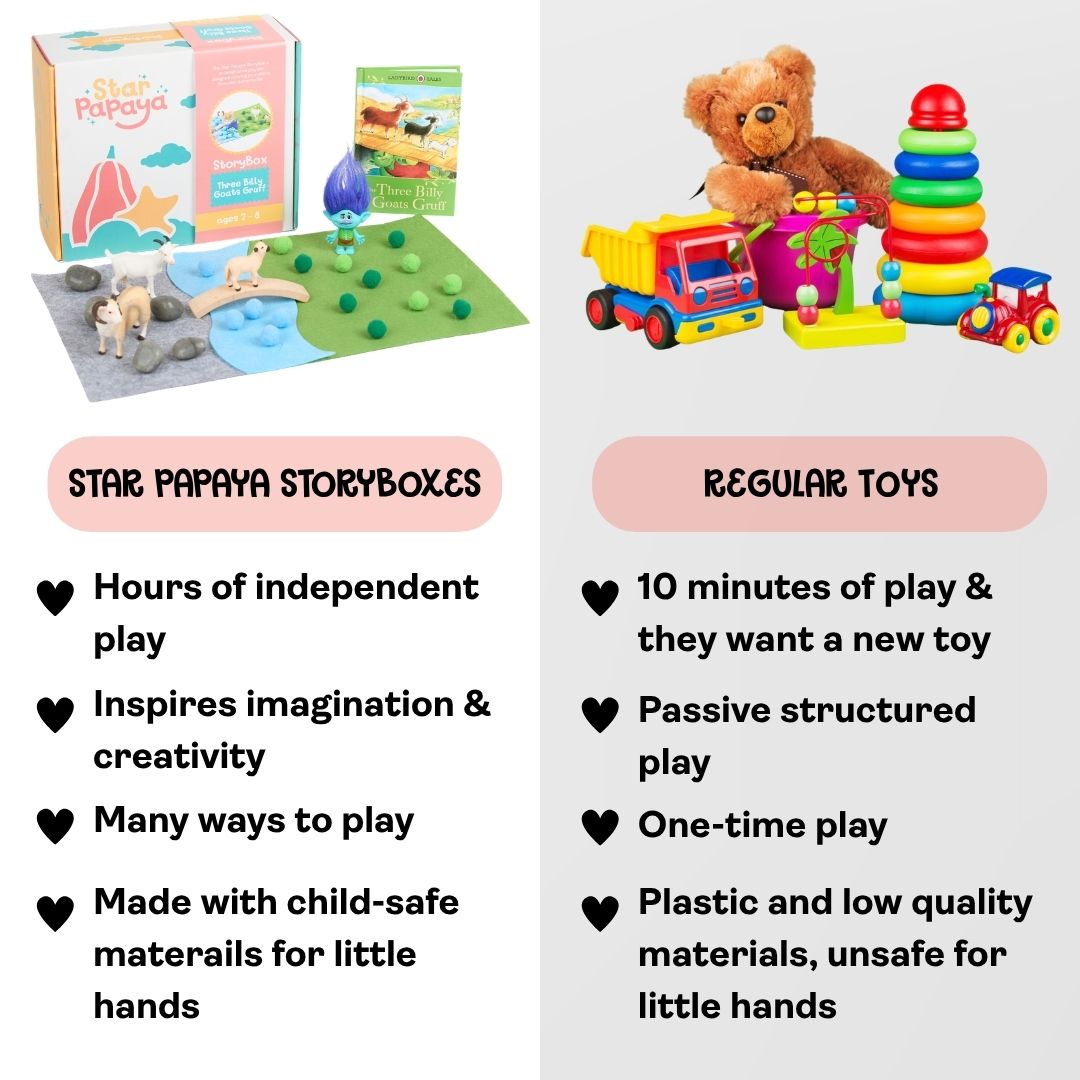
Overstimulating toys and screens can overwhelm young brains. Research shows that simple, child-directed play encourages deeper engagement and stronger focus, because children are not reacting to lights and sounds — they are creating the play.
“Children learn best when they are free to explore at their own pace.” — National Institute for Play
Screen-Free Development: What Research Shows
Hands-on play supports richer learning than passive screen time. The American Academy of Pediatrics recommends screen-free, real-world play in early childhood because it builds language, social interaction, problem-solving, and emotional regulation.
Storytelling & Language Skills: The Connection
Storytelling isn’t just fun - it’s foundational for language development. When children act out a narrative, they expand vocabulary, sequence events, and practice expressive speech. Studies show that shared story play significantly builds communication and literacy readiness.
“Play gives children a chance to practice what they are learning.” — David Elkind, Child Development Expert
Open-Ended Play vs. Prescribed Toys
Toys with one “right” way to play limit imagination. Open-ended materials like StoryBox sets invite creativity, flexible thinking, and problem-solving - traits children need both for school and life.
“Open-ended play helps children make choices, plan ahead, and think creatively.” — Harvard Medical School
What This Means for Your Family
Choosing play that is unstructured, screen-light, and imaginative isn’t just a parenting preference — it’s backed by research. Join us in bringing home imaginative and independent play for the entire family!
Shipping
Ships within 1 business day | Delivered in 3–5 days 🚚✨
Need it faster? Choose Express Delivery (1–2 business days) for just ₹400.
If you’re in Hyderabad, we also offer same-day delivery for orders placed before 4pm, at the same cost as express delivery. Contact us at +91 70758 79620.
Free returns/exchanges in case of any incorrect or defective items. Just contact us within 7 days of delivery — we’ll take care of the rest! 💛

Watch the fun!
Why Families Choose Us
The pieces are perfectly sized for little hands and sturdy enough for daily use. A lovely balance of fun and early learning.